Writing
Dual numbers II
Dual numbers II
TL;DR: Dual numbers (where $i^2 = 0$) give us first derivatives for free. To get higher-order derivatives we introduce independent infinitesimals $i_1, i_2, \ldots$, each with $i_k^2 = 0$ but $i_j i_k \neq 0$. This gives a clean, recursive route to higher-order automatic differentiation. And the labels on the infinitesimals turn out to be the very same labels we saw on special labeled rooted trees, tying together algebraic number systems, autodiff, and combinatorics in one picture.
In the dual numbers post we built a number system for first derivatives. In the rooted trees post we saw that higher-order derivatives of composed functions are indexed by labeled trees. This post ties the two together: extending the dual number algebra to higher orders and showing that the infinitesimal labels are precisely the tree labels.
A quick recap
Recall the core idea. The dual numbers extend the reals with an infinitesimal $i$ satisfying $i^2 = 0$ (but $i \neq 0$). Evaluating a function at $x + i$ and Taylor expanding, the higher-order terms die and we get
$$ f(x + i) = f(x) + i\,\color{red}{f'(x)}. $$The derivative is just the $i$-component. And we get the chain rule for free: $f(g(x+i)) = f(g(x)) + i\,\color{red}{f'(g(x))\,g'(x)}$.
The goal: second derivatives of composed functions
What we would really like is to extend this to higher-order derivatives. To see what we are aiming for, recall from the rooted trees post that the second derivative of a composition $f(g(\textbf{x}))$ is
$$ \frac{\partial^2 f}{\partial x^j \partial x^k} = f_{\alpha\beta}\, g^\alpha_j\, g^\beta_k + f_\alpha\, g^\alpha_{jk}. $$Notation recap: subscripts denote derivatives with respect to a function's input ($f_\alpha = \partial f / \partial y^\alpha$, $f_{\alpha\beta}$ its Hessian), superscripts label output components ($g^\alpha_j$ is the Jacobian, $g^\alpha_{jk}$ the Hessian of $g$). Greek indices ($\alpha, \beta, \ldots$) are summed over; Latin indices ($j, k, \ldots$) are free.
In words: the Hessian of $f$ pulled back through the Jacobian of $g$, plus the gradient of $f$ contracted with the Hessian of $g$. Can we design an algebraic system where this falls out as a coefficient?
First attempt: reusing the same infinitesimal
The most naïve approach is to apply the dual number trick twice with the same $i$. Substituting $x + i$ for $x$ in $f(x+i) = f(x) + if'(x)$ gives $f(x + 2i) = f(x) + 2i f'(x)$. The $i$-component is $2f'(x)$, not $f''(x)$. Using the same $i$ twice, the system cannot tell the two perturbations apart. This is known as perturbation confusion.
The fix: independent infinitesimals
The fix is to give each differentiation its own infinitesimal. Introduce $i_1$ and $i_2$ with $i_1^2 = 0$ and $i_2^2 = 0$, but $i_1 i_2 \neq 0$. Each knows only about its own perturbation. A general number is
$$ z = a + b\,i_1 + c\,i_2 + d\,i_1 i_2, $$a 4-tuple $(a, b, c, d)$. These are hyper-dual numbers. The multiplication rule follows from distributing and setting squared terms to zero:
$$\begin{aligned} (a + b\,i_1 + c\,i_2 + d\,i_1 i_2)(e + f\,i_1 + g\,i_2 + h\,i_1 i_2) &= ae \\ &\quad + (af + be)\,i_1 \\ &\quad + (ag + ce)\,i_2 \\ &\quad + (ah + bg + cf + de)\,i_1 i_2. \end{aligned}$$Evaluating a function
Evaluating $f$ at $x + i_1 + i_2$ and noting that $(i_1 + i_2)^2 = 2\,i_1 i_2$ (the self-interactions die), we get
$$ f(x + i_1 + i_2) = f(x) + i_1\,f'(x) + i_2\,f'(x) + i_1 i_2\,f''(x). $$The $i_1 i_2$ component is exactly $f''(x)$. Now the real test: does composition work?
Derivation: expanding $f(g(x + i_1 + i_2))$
We already know $g(x + i_1 + i_2) = g + i_1 g' + i_2 g' + i_1 i_2\,g''$ (dropping arguments for brevity). Taylor-expanding $f$ around $g$:
$$\begin{aligned} f(g + \underbrace{i_1 g' + i_2 g' + i_1 i_2\,g''}_{\delta}) &= f(g) + \delta\,f'(g) + \tfrac{1}{2}\delta^2\,f''(g) + \cdots \end{aligned}$$We need $\delta$ and $\delta^2$. The linear term is straightforward:
$$ \delta\,f'(g) = i_1\,g'\,f'(g) + i_2\,g'\,f'(g) + i_1 i_2\,g''\,f'(g). $$For $\delta^2$, every product $i_k^2 = 0$, so the only surviving cross-term is $2(i_1 g')(i_2 g') = 2\,i_1 i_2\,(g')^2$. Thus $\tfrac{1}{2}\delta^2 f''(g)$ contributes $i_1 i_2\,(g')^2\,f''(g)$. All higher powers of $\delta$ vanish.
Collecting terms:
$$ f(g(x + i_1 + i_2)) = \color{gray}{f(g)} + \color{gray}{i_1\,f'(g)\,g'} + \color{gray}{i_2\,f'(g)\,g'} + i_1 i_2 \bigl[\,\underbrace{f''(g)\,(g')^2 + f'(g)\,g''}_{(f \circ g)''}\,\bigr]. $$The $i_1 i_2$ coefficient is precisely the second derivative of $f(g(x))$.
Nesting as composition of first-order algebras
Here is the really nice part. Hyper-dual numbers are not a new algebra. They are the first-order dual number algebra composed with itself. A hyper-dual number $a + b\,i_1 + c\,i_2 + d\,i_1 i_2$ can be regrouped as
$$ \underbrace{(a + c\,i_2)}_{\text{primal}} + i_1 \underbrace{(b + d\,i_2)}_{\text{tangent}}, $$which is just a dual number in $i_1$ whose components are dual numbers in $i_2$.
So we don't need a hyper-dual class at all. We reuse Dual from part I
and nest it. This matters because a dedicated hyper-dual implementation only handles
second derivatives; for thirds we would need yet another class. Nesting generalises for
free.
Here is the key insight. In part I we represented a dual number as a tuple of floats:
# Part I: primal and tangent are floats
def dtan(z):
    x, y = z                  # x: float, y: float
    return np.tan(x), y * (1 + np.tan(x)**2)
This works for first derivatives, but we can’t nest it, because the components
are locked to plain numbers. The fix is to make the arithmetic
generic: let the primal and tangent be anything that supports
+ and *, including other Duals.
That single change turns a first-order system into an arbitrarily
high-order one:
class Dual:
    def __init__(self, primal, tangent=0):
        self.primal = primal       # f(x)
        self.tangent = tangent     # f'(x)

    # (a + b·i) + (c + d·i) = (a+c) + (b+d)·i
    def __add__(self, other):
        if not isinstance(other, Dual):  # promote scalar c → Dual(c, 0)
            other = Dual(other)
        return Dual(self.primal + other.primal,
                    self.tangent + other.tangent)

    # (a + b·i)(c + d·i) = ac + (ad + bc)·i
    def __mul__(self, other):
        if not isinstance(other, Dual):
            other = Dual(other)
        return Dual(self.primal * other.primal,
                    self.primal * other.tangent
                    + self.tangent * other.primal)

    # __radd__, __rmul__ omitted for brevity
Some examples to build intuition:
Dual(3, 1)                        # 3 + i          (first-order seed)
Dual(Dual(3, 1), Dual(1, 0))     # (3 + i₂) + i₁(1 + 0·i₂)
                                  # = 3 + i₁ + i₂  (second-order seed)
Dual(Dual(Dual(3,1), Dual(1,0)),
     Dual(Dual(1,0), Dual(0,0))) # = 3 + i₁ + i₂ + i₃  (third-order seed)
Notice the redundancy: the second-order seed has $2^2 = 4$ components,
but only 3 distinct values ($x$, $1$, $0$). After evaluation,
result.primal.tangent and result.tangent.primal
both store $f'(x)$. The two $i_1$ and $i_2$ channels carry
duplicate information. At order $n$ we are hauling $2^n$ components
when only $n+1$ are distinct. We will return to this
below.
And the primitives are defined recursively. If the input is a Dual,
apply the chain rule; the components may themselves be Duals:
import numpy as np

def tan(z):
    if isinstance(z, Dual):
        t = tan(z.primal)         # recurse on primal
        dt = 1 + t * t            # tan'(x) = 1 + tan²(x)
        return Dual(t, z.tangent * dt)
    return np.tan(z)              # base case: plain float
The same tan function handles first, second, and third
derivatives, because the recursion on Dual components
naturally peels off one layer of nesting at a time. Let's test it.
First derivative
z = Dual(2.0, 1.0)      # x + i
result = tan(z)
print(f"tan'(2) = {result.tangent:.6f}")  # 5.774399
Second derivative (nested)
The seed $x + i_1 + i_2$ is
Dual(Dual(x, 1), Dual(1, 0)). The outer Dual
carries $i_1$, the inner carries $i_2$:
z = Dual(Dual(2.0, 1.0), Dual(1.0, 0.0))
result = tan(z)
print(f"tan''(2) = {result.tangent.tangent:.6f}")  # -25.234585
Composition works too: tan(tan(z)) gives the correct
second derivative of $\tan(\tan(x))$ with no extra effort.
Third derivative (triple nesting)
z = Dual(Dual(Dual(2.0, 1), Dual(1, 0)),
         Dual(Dual(1, 0),    Dual(0, 0)))
result = tan(z)
print(f"tan'''(2) = {result.tangent.tangent.tangent:.4f}")  # 176.9645
No new classes, no new primitives. (Yes, result.tangent.tangent.tangent
is cumbersome, but that is just syntax that can be cleaned up; the
point is the algebra.) This is essentially what JAX does when you nest
jvp calls: each call introduces a fresh perturbation tag.
The general pattern
For the $n$th derivative we nest $n$ layers, each with its own infinitesimal $i_1, \ldots, i_n$ ($i_k^2 = 0$). The seed is $x + i_1 + \cdots + i_n$ and the $n$th derivative lives in the coefficient of $i_1 i_2 \cdots i_n$.
There are $2^n$ components in total, one per subset of $\{1, \ldots, n\}$. But most of them are redundant! Recall the second-derivative expansion:
$$ f(x + i_1 + i_2) = f(x) + i_1\,{\color{#5b9bd5}f'(x)} + i_2\,{\color{#5b9bd5}f'(x)} + i_1 i_2\,f''(x). $$The $i_1$ and $i_2$ components both store ${\color{#5b9bd5}f'(x)}$: the same value twice. In general, all $\binom{n}{k}$ subsets of size $k$ store $f^{(k)}(x)/k!$. So of the $2^n$ components, only $n+1$ are distinct.
Exploiting the symmetry
Mathematically, the infinitesimals $i_1$ and $i_2$ are interchangeable; swapping them
changes nothing. We can see this directly in the Dual representation.
After evaluating tan at the second-order seed:
z = Dual(Dual(2.0, 1.0), Dual(1.0, 0.0))
result = tan(z)
print(result.primal.tangent)  # f'(x) via i₂
print(result.tangent.primal)  # f'(x) via i₁  — same value!
This is not a mathematical issue. Both components must agree by the permutation symmetry of the infinitesimals. It is an implementational one: we are doing redundant work. The truncated polynomial algebra exploits this. Instead of $n$ independent infinitesimals, use a single one with the relaxed condition $i^{n+1} = 0$. A number is now just an $(n+1)$-tuple:
$$ f(x + i) = f(x) + i\,f'(x) + \frac{i^2}{2!}\,f''(x) + \cdots + \frac{i^n}{n!}\,f^{(n)}(x). $$This is $n+1$ components instead of $2^n$, a massive saving. Multiplication
becomes polynomial convolution truncated at degree $n$, costing $O(n^2)$
per primitive evaluation. In practice, most common primitives ($\exp$, $\sin$,
$\tan$, etc.) have the nice property that higher-order derivatives can
be expressed in terms of lower-order ones. For instance, $\tan'(x) = 1 + \tan^2(x)$,
so the jet can be propagated cheaply from the primals within your set of primitives.
Griewank and Walther (2008) cover this in detail.
This is what JAX's jet transform implements.
To summarise: nested dual numbers build higher-order differentiation from the first-order algebra alone, with no new rules, just nesting. Conceptually the cleanest, but $2^n$ scaling. Truncated polynomials collapse the redundancy to $n+1$ scaling, at the cost of dedicated higher-order rules per primitive.
The connection to rooted trees
Here is where things come full circle. In the rooted trees post we saw that the higher-order chain rule for $f(g(x))$ is a sum over special labeled rooted trees. The second derivative is represented by two trees:
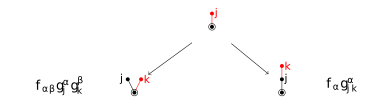
The left tree is $f_{\alpha\beta}\,g^\alpha_j\,g^\beta_k$ (Hessian of $f$ pulled back through the Jacobian of $g$) and the right is $f_\alpha\,g^\alpha_{jk}$ (gradient of $f$ contracted with the Hessian of $g$). The labels $j, k$ on the nodes are what make them labeled rooted trees.
Now look at our nested dual numbers. In the rooted trees, the labels $j, k$ are input dimensions: they tell us which partial derivative we are taking. The infinitesimals $i_1, i_2$ seem different: they tag independent applications of the differential operator. How are these related?
The bridge is the seed. To compute $\frac{\partial^2 f}{\partial x^j \partial x^k}$ with hyper-duals, we seed $\textbf{x} + i_1\,\textbf{e}_j + i_2\,\textbf{e}_k$, where $\textbf{e}_j$ is the $j$th basis vector. Now $i_1$ carries direction $j$ and $i_2$ carries direction $k$. The infinitesimal index becomes the tree label. The algebra does the rest: $i_1^2 = i_2^2 = 0$ ensures each direction is differentiated at most once, while $i_1 i_2 \neq 0$ lets the cross-derivatives survive. Look back at our expansion of $f(g(x + i_1 + i_2))$: the $i_1 i_2$ coefficient was $f''(g)(g')^2 + f'(g)g''$, which is exactly one term per second-derivative tree. Each leaf of a tree gets one infinitesimal label ($i_1$ or $i_2$), and the squaring rule prevents any label from appearing twice.
Three perspectives on the same object: Faà di Bruno's formula, labeled rooted trees, and nested dual numbers.
References
- Fike, J.A. and Alonso, J.J. (2011). The Development of Hyper-Dual Numbers for Exact Second-Derivative Calculations. AIAA 2011-886.
- Griewank, A. and Walther, A. (2008). Evaluating Derivatives: Principles and Techniques of Algorithmic Differentiation. SIAM.
- Bettencourt, J. et al. (2019). Taylor-Mode Automatic Differentiation for Higher-Order Derivatives in JAX.
- Dual numbers I
- On rooted trees and differentiation